Ever typed something into Google and landed on a page that answered your question perfectly? That’s SEO doing its job.
So what is SEO, really? Let’s break it down in plain, no-jargon terms. By the end of this guide, you’ll know exactly how to start getting your own website noticed on Google.
What Is SEO? A Simple Definition
SEO stands for Search Engine Optimization. Basically, it’s everything you do to help Google (and other search engines) find your website, understand what it’s about, and show it to people searching for related stuff.
Think of it this way: Google wants to give people the best possible answer to their search. In other words, SEO is how you convince Google that your page IS that best answer.
For example, when someone Googles “best coffee shops near me” or “how to remove a wine stain,” SEO decides which pages show up first – and which ones get buried on page five, where nobody ever looks.
Why Should You Even Care About SEO?
Because Google handles over 8.5 billion searches every single day. That’s a massive number of people looking for answers, products, and solutions. As a result, if your website shows up on page one, you get a slice of that traffic for free.
Here’s what good SEO actually gets you:
- Free, ongoing traffic – no ad budget required
- More trust – people assume top-ranking sites are credible
- A better website overall – SEO pushes you to make your site faster and easier to use
- Real, long-term results – unlike ads, SEO traffic doesn’t vanish the second you stop spending
Okay, But How Does SEO Actually Work?
First, Google uses little bots (called crawlers) that constantly scan the internet, hopping from link to link, collecting info on every page they find. That’s called crawling.
Once a page gets crawled, it then gets stored in Google’s giant database – this step is called indexing.
Finally, when someone types in a search, Google digs through that index and decides which pages deserve the top spots. That’s ranking.
So really, it comes down to three simple questions:
- Can Google find your page? (crawling)
- Does Google understand your page? (indexing)
- Does your page deserve to rank high? (ranking)
The Three Building Blocks of SEO
If you’re learning what SEO is for the first time, everything basically falls into three buckets.

1. On-Page SEO
This is stuff you control directly on your site:
– Using the right keywords naturally in your titles and content
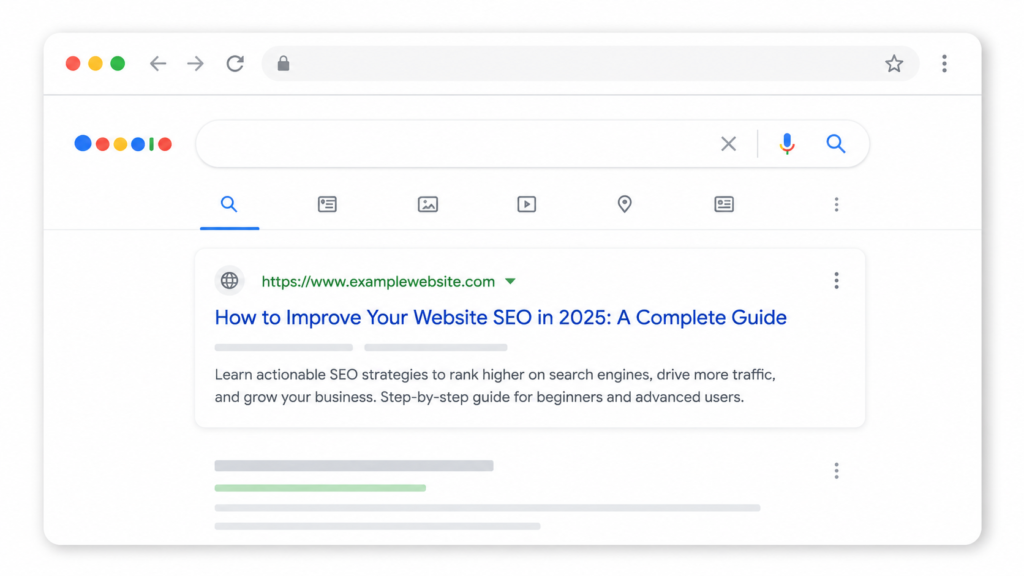
– Writing clear, clickable titles and meta descriptions
– Organizing content with proper headings (H1, H2, H3)
– Writing content that’s actually useful, not fluff
– Linking to other relevant pages on your own site, such as our keyword research guide
– Adding alt text to images
– Keeping URLs short and readable
2. Off-Page SEO
This is what happens outside your website that still affects your rankings. The big one here is backlinks – other websites linking back to you. Google treats these like votes of confidence. Get enough good ones, and your site starts looking trustworthy.
Additionally, other things that help include:
– People mentioning your brand online
– Getting shared on social media
– Guest posting on other relevant sites
– Getting featured by journalists or influencers
For a deeper dive into building authority, check out our link building strategies guide.
3. Technical SEO
This is the behind-the-scenes stuff that makes sure Google can actually crawl and understand your site properly:
– Site speed – slow sites frustrate users and hurt rankings
– Mobile-friendliness – most searches now happen on phones
– HTTPS – a secure connection is a must
– XML sitemaps – helps Google find all your pages
– Structured data – helps Google (and AI tools) understand your content better
– No broken links or duplicate content
If you want a full walkthrough, see our technical SEO checklist.
How to Actually Start Ranking on Google (Step-by-Step)
Step 1: Figure Out What People Are Searching For
Start with keyword research. Tools like Google Search Console can show you what people are typing in, how often, and how competitive it is. Meanwhile, pay attention to intent – are they trying to buy something, learn something, or compare options?
Step 2: Write Content That’s Actually Helpful
Google rewards content that shows real experience and expertise – often called E-E-A-T (Experience, Expertise, Authoritativeness, Trustworthiness). In other words, don’t write fluff. Instead, answer the question thoroughly, and make it obvious you know what you’re talking about.
Step 3: Optimize the Basics
Once your content’s written, here’s what to check next:
– Put your main keyword in the title, intro, and at least one subheading
– Write a short, compelling meta description
– Break things up with short paragraphs and bullet points
– Link to related pages on your own site
Step 4: Speed Things Up
Next, run your site through Google PageSpeed Insights. Then, compress images, use decent hosting, and clean up anything slowing your pages down.
Step 5: Earn Some Backlinks
Create content people actually want to link to – original data, deep guides, whatever’s genuinely useful. After that, reach out, guest post, and get involved in your niche’s community.
Step 6: Keep an Eye on Your Progress
Ultimately, SEO isn’t “set it and forget it.” Therefore, check Google Search Console and Analytics regularly to see what’s working and what needs tweaking.
Mistakes Beginners Make All the Time
- Stuffing keywords everywhere – it reads badly and can actually hurt you
- Forgetting about mobile users – that’s most of your traffic
- Ignoring page speed – slow site, fewer visitors
- Copying content – it almost never ranks
- Expecting quick results – SEO takes months, not days
SEO in the Age of AI Search
Search is changing fast. Tools like Google’s AI Overviews now summarize answers directly, often pulling from clear, well-organized, trustworthy content. As a result, the fundamentals matter more than ever:
- Write clearly and answer questions directly
- Use structured data so AI tools can “read” your content easily
- Build real authority instead of chasing shortcuts
FAQs About SEO
1. What is SEO in simple terms?
SEO is the process of optimizing your website so it ranks higher on Google for relevant searches.
2. What are the 3 types of SEO?
On-page, off-page, and technical SEO.
3. How long does SEO take to work?
Usually 3–6 months, sometimes longer for competitive keywords.
4. What’s the difference between SEO and SEM?
SEO is free/organic traffic. SEM, on the other hand, is paid traffic, like Google Ads.
5. What is a keyword in SEO?
A word or phrase people type into search engines when looking for something.
6. Do I need to pay for SEO?
Not necessarily – basic SEO can be done for free with the right tools and effort.
7. What is a backlink?
A link from another website to yours. It signals trust to Google.
8. Can beginners do SEO themselves?
Yes – with free tools like Google Search Console, anyone can get started.
9. Is SEO still important with AI search tools?
Yes, even more so. AI tools pull from well-optimized, trustworthy content.
Conclusion
So, what is SEO in a nutshell? It’s the ongoing process of making your website easy for Google to find, understand, and recommend, while also making it genuinely useful for real people.
It’s not a quick fix. However, if you stick with the basics – good content, solid technical health, and real authority – SEO pays off in a way paid ads never will. So start small, stay consistent, and the traffic will follow.
